Showing posts with label extreme environments. Show all posts

Monday, 23 September 2013

5 mind-bending facts about the universe


Let me tell you a secret. Every biologist secretly wishes they had studied physics instead. I certainly do. As a science writer I also love to write about physics. Why? Because physics is sexy. And also images from NASA are free.

Physics is slowly becoming the new rock n’ roll – with celebrity popularizers of science like Brian Cox and Michio Kaku and historic scientific efforts such as the Large Hadron Collider becoming more and more popular every day. Everyone loves a bit of physics. It is a fascinating subject, after all.

Anyways, to round up the series of physics-heavy articles I give you a collection of five mind-bending physics facts about our happy little universe. Feel free to use them to impress people, get dates or satisfy your curiosity.  

1.All the matter that makes up the human race could fit in a sugar cube.

Don’t look at me like that. It will probably surprise you to know that 99.9999999999999% of matter is actually empty space. We most likely all learned about the structure of matter in school: all matter is made up of atoms which are made up of neutrons, protons and electrons. The protons have a positive charge and they group together with the uncharged neutrons to make a positively charged nucleus. This nucleus is kinda like the sun in the centre of our solar system and around the nucleus orbits the tiny, negatively charged electrons – kind of like the planets orbiting the sun. 

You can just about make me out - I'm about three billion atoms in © picsfive - Fotolia.com
If we were to somehow step inside an atom we would realise that the nucleus is like the head of a pin and the space in which the electrons zip around is like a football stadium and the electrons themselves would be the size of a bumblebee. If all this empty space wasn’t there, all of us would fit inside a single sugar lump. Considering the fact that all atoms are by far mostly empty space, why does all matter have mass? This is because of the Higgs field. The Higgs field is an invisible net of energy which exists through the universe associated with its own particle called a Higgs boson – famously discovered by the LHC supercollider in Switzerland last year. The Higgs field acts like a swamp – particles which travel through it are given the property of mass, just like a runner would be slowed down by running through a swamp. Different particles are slowed by the field to differing extents, which gives objects differing mass.
Of course, the sugar cube would still have mass so it would weight something like 5 billion tons – good luck putting that in your hot beverage of choice.

2.If the sun were to suddenly blink out of existence we wouldn't notice for eight minutes.
It's the sun! As far as I know it's still where it's supposed to be. You'll just have to take my word for it for 8 minutes. (Source: NASA)

The speed of light is about 300, 000, 000 meters per second and the sun is 149,600,000 km from planet Earth – that equates to about 8 light minutes. If the sun were to suddenly blink out while you were reading this (let’s say a star-hungry space whale had it for dinner) the light it was radiating at the moment of its disappearance would take 8 minutes to reach your eyes. That’s just long enough to have a sandwich before the world ends!


3. When things move they get heavier.

I discussed this one in my last article, but I thought it warranted a second mention – particularly if anyone hasn’t read the last one. Albert Einstein’s famous equation of relativity E=mc2 tells us that energy (E) and mass (m) are simply two different forms of the same thing – meaning that energy has mass. The faster something moves, the more kinetic energy it has (kinetic energy is the energy of movement) and therefore the more mass it has.

Obviously we don’t really notice this in real life, but it does happen – it is just that the percentage of energy which is turned into mass is incredibly tiny at the speeds we experience here on earth. At speeds approaching light speed this becomes much more dramatic, and if it were possible for something with mass to move at the speed of light it would, in theory, become infinitely massive.

4. There is a planet made out of burning ice.
 
Gilese 436b - ideal weather for... a fire breathing yeti? (Source: NASA)
Somewhere out there in space is, you guessed it, a planet completely coated in ice… which is on fire. A confusing place to say the least. The catchily-named Gliese 436 b is a Mercury-sized planet which closely orbits the star Gilese 436 near the constellation of Leo. The planet orbits the star so closely -4.3 million miles (it doesn’t sound close but that is 15 times closer to the star as Mercury is to our sun) – that its surface is constantly at the scorching temperature of 439°C. You might be thinking that it is impossible for frozen water to exist at such an insane temperature – and you would be 100% correct. But as with almost everything in science, there are exceptions to the rules.

In order to understand how 439°C ice can exist, we need to take a look at the difference in structure between ice, water and steam. As we all know, water exists in three states depending on its temperature. This is because the water molecules (made up of a single oxygen atom and two hydrogen atoms) have differing levels of kinetic energy. Ice molecules have very low levels of energy and therefore don’t move around much. This means that they are very ordered and still (but not completely) and very close together which gives ice its solid structure. As temperature increases the molecules become more energetic and move more – this gives rise to water and steam as the particles become more energetic and less ordered. In chemistry this is called entropy, which is a measure of the disorder of the molecules. Steam has higher entropy than water and water has higher entropy than ice.

On Gliese 436 b, most of the planet is made up of water surrounding a small core made of rock. Gravity from the planet core pulls the water molecules on the planet very close together into a more ordered, less entropic state called Ice X (ice ten or hot ice) which remains in a solid state regardless of the 439°C temperature of the entire planet surface. Don't touch it - your arm would be vaporized. So, y'know, wear sunscreen.

5. We really have no idea what is going on.

I think we can all agree that there is a lot of stuff in the universe. All this stuff – planets, stars, life – is made up of matter. Astrophysicists figure that all the matter that exists only accounts for about 4% of the universe. As for the other 96? Nobody knows apparently.

Mysterious, right? (Source: NASA)
Science proposes that 73% of the universe is made up of something called dark energy and the remaining 23% is made up of something called a dark matter. The Big Bang theory states that the universe ‘exploded’ out of an infinitely dense point at the beginning of time and has been expanding in size ever since. According to the laws of physics, the expansion of the universe should be slowing down– but this is not the case. The rate of the expansion of the universe is actually accelerating and nobody is really sure why. The leading theory as to why this happens is down to dark energy acting like an opposite to gravity, pulling matter apart. Dark matter on the other hand is something that science thinks exists but doesn’t really understand.

Basically it’s a fancy way of saying ‘Who knows?’

And that about sums it up. Join us next time for some fascinating critters!

Thanks for reading, remember to check out and Like the Facebook page (https://www.facebook.com/scienceunplugged) to support ScienceUnplugged and to see notifications of new posts, science news and interesting things.

As with every article I post here, this one has been thoroughly researched and a list of sources can be provided for anyone who is curious – just check out the contact page.

Thursday, 5 September 2013

Extremophiles: life in extreme places


Underwater volcanoes, arctic tundra and the reactor at Chernobyl- what do these places have in common? As strange as it might seem, they are the ideal living conditions for several different microorganisms. Think humans are the best at colonising Earth? Think again.


Deadly Radiation Levels: Chernobyl


The exploded reactor at Chernobyl (source)
About 70 miles away from Kiev in Ukraine lies the ruined reactor of the Chernobyl nuclear power plant and the eerie abandoned city of Prypiat.  In April 1986 during a security test at the plant, a huge explosion tore through the nuclear reactor, throwing its 1200 tonne cover high into the air, carrying with it a cloud of radioactive graphite dust and exposing the surrounding areas with lethal levels of radiation. To this day the clean-up of the fallout from this incident continues and a 2,600 exclusion zone has been put in place where no people live except for about 170 samosely – or settlers - who remained behind after the incident. Nobody is quite sure how many people died as a result of the power plant disaster, but estimates go as high as tens of thousands.


Given the catastrophic nature of this incident and the hostility of the area around the plant, it’s pretty surprising that it has been discovered in the last few years that black pigmented fungi grow and actually thrive on the walls of the broken down reactor. Normally gamma radiation (the most harmful form of radiation, the type given off by unshielded nuclear reactors and exploded atom bombs) causes irreparable damage to the DNA of living organisms, rendering them unable to function or reproduce.


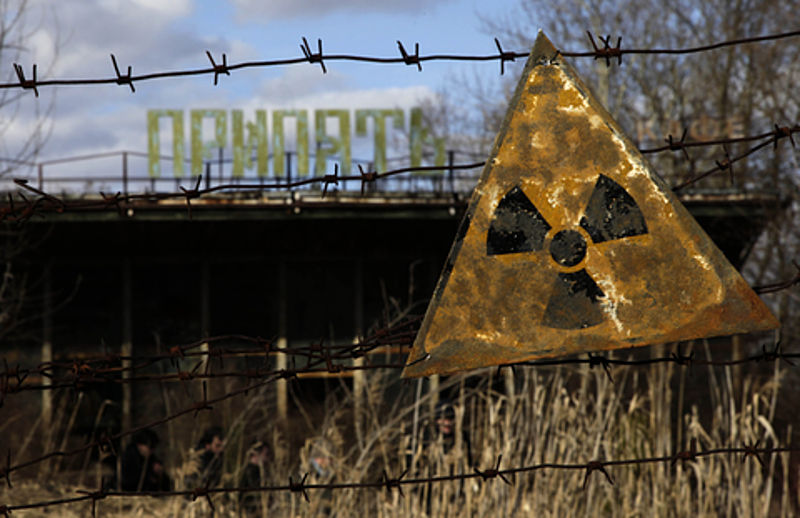
The iconic radiation warning at Prypiat (source)
Turns out that the amazing ability these fungi have to thrive in these conditions is down to melanin- the same stuff that gives us moles and freckles. Along with many other organisms, some fungi produce melanin, which gives them a characteristic black colour. Scientists believe that these fungi use melanin to convert the deadly gamma radiation from the crippled reactor to energy they can use to grow. Lab tests with one such fungus, called Cryptococcus neoformans (I’m trying to spare the meaningless unpronounceable Latin names, but apparently us microbiologists are sticklers for it – sorry) showed that it grew three times faster than normal at 500 times the normal radiation found on Earth’s surface.


So, that’s the crazy radiation-munching fungi dealt with – let’s move on to heat, and another awesome environment.


Extreme Temperature and Pressure: Deep Sea Hydrothermal Vent Fields


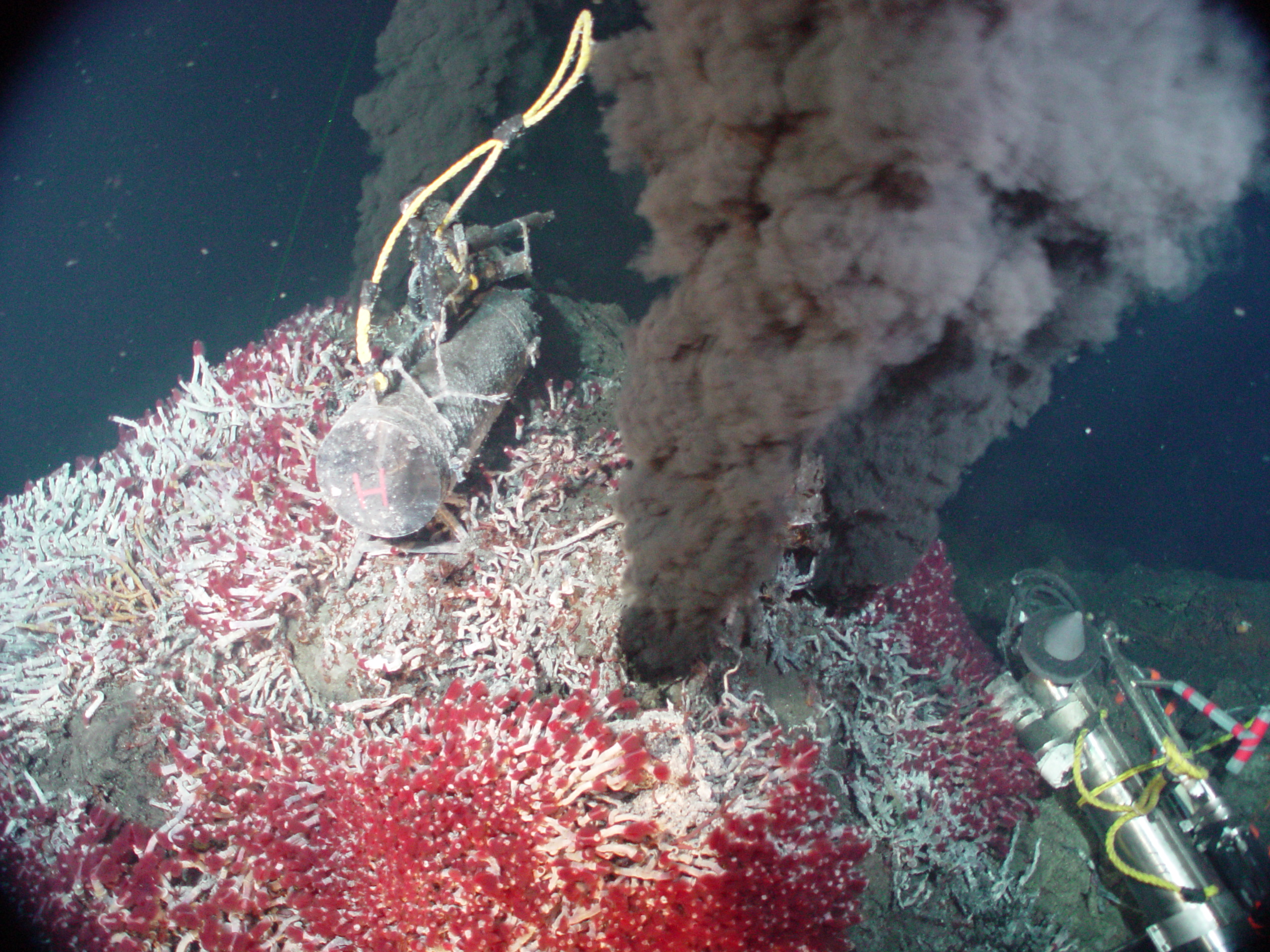
A black smoker. I'd make a joke but it wouldn't be clever or funny (source)
Hydrothermal vent fields are probably some of the most hostile places on earth and they are freaking awesome. Uhh… that wasn’t very scientific – they are quite interesting. Better? Anyway, hydrothermal vents are holes in the Earth’s crust in volcanic regions which spew mineral rich water heated by molten rock. When this material hits the cold water some of it solidifies creating a chimney through which dissolved minerals issue like white and black smoke. These chimneys, not surprisingly, are called black smokers and white smokers. 


The water in these places can reach temperatures up to 400 degrees and the pressure is several times that of the surface, but amazingly they are some of the most life-filled places in the deep sea.  Discovered in 1970, these vents are relatively new to science, but in spite of this over 300 species have been identified in vent fields – more than 280 of which were completely new to science. The combined biomass (the total mass of living things) in these vent fields is estimated to be the same as the rainforest.


The thriving life in these hydrothermal vent fields is made up of bacteria, tubeworms, crabs, slugs, fish and many more. Like all life on this planet, the smallest lifeforms make it all possible. One of the components of the ‘smoke’ spewing out of the vents is hydrogen sulphide – a gas with a characteristic rotten egg smell which is toxic to most life in high levels. This gas is the primary food source for the microorganisms that live there. These microorganisms make up the bottom rung of the food chain, allowing more complex life to survive by feeding on them. These microbes have to be specially adapted to live in such a place, as high temperature and pressure destroy the structure of cells and damage the proteins that make them work – in fact it is temperature and pressure that are used to sterilise laboratory and medical equipment through a process known as autoclaving.The types of microbes that survive down here are ones whose internal components are highly resistant to such damage.


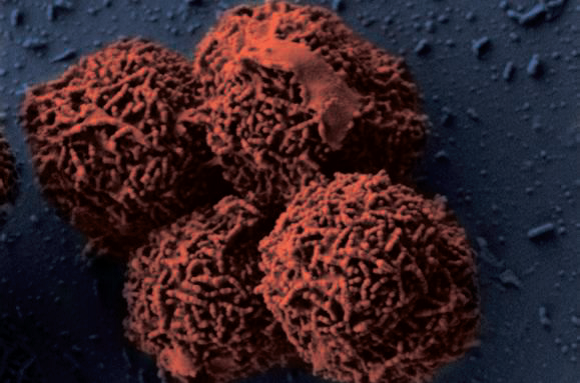
M. kandleri - fascinating AND pretty (source)
One of these microbes, called Methanopyrus kandleri  (sorry!) is the world record holder for life at high temperatures.  M. kandleri is an archaeon – a member of the archea which are similar to bacteria but are quite different at a genetic level and often to live in extreme and methane gas rich environments – either producing it or using it as an energy source. M. kandleri was discovered on the wall of a black smoker vent and grows happily at 110°C and can survive up to 130°C. Science classifies this awesome little bug as a hyperthermophile, meaning ‘extremely high temperature lover’.


Sub-zero Temperatures: Arctic Permafrost


Whenever people think of inhospitable conditions the Arctic tundra is probably pretty high on the list. I keep thinking of arctic explorers fighting their way through blizzard in huge fur coats with their big bushy beards caked with snow… but maybe that’s just me. One critter that loves to live in the arctic permafrost is the fetchingly-named Planococcus halocryophilus. This one is an extreme survival double-whammy. It is capable of growing at ultra-low temperatures and ultra-high salt concentrations.


P. halocryophilus in the flesh... or whatever they are made of (source)
P. halocryophilus was discovered in 2011 in the Canadian High Arctic where scientists believe they grow in the permafrost – the frozen soil on the surface of the Arctic. These bugs are reported to live in tiny regions of highly salty water in the permafrost, which creates a particularly demanding environment of high salinity (salt content) and sub-zero temperatures. P. halocryophilus has been shown to grow happily at the ambient permafrost temperature of -16°C and survive up to -25°C and has been referred to as a ‘cold temperature champion’.


Normally bacteria are killed by extremely low temperature when water inside the cells freezes or the temperature slows or stops the chemical processes that keep them alive. When water freezes it tends to form crystals which tear through cell walls and render them useless. Cold-loving bacteria (cryophiles) protect themselves by producing their own kind of antifreeze inside and out which prevents them from freezing solid or being killed by ice crystals. P. halocryophilus is able to survive at such low temperatures by doing just that, as well as being highly adapted to be cold-resistant.


So, if you didn’t before, you now know about three of the world champions of survival, and yes, they are all microbes – in microbiology these are called ‘extremophiles’. “That’s all very well” you might be saying, “but so what?” – which is a fair question. Probably the most fascinating thing about these extremophiles is the fact that they provide us with a window to other worlds. I know, right? I made that sound super dramatic. What I am talking about here is xenobiology – the study of extra-terrestrial life. I’m not talking about the E.T., X-files, take-a-deep-breath-here-comes-the-probe type of extra-terrestrial life, I’m talking about microbes. Some of these extreme environments on earth closely mirror what conditions might be like on other planets and studying the life that thrives in them tells us about the possibility of life on other planets. Microbiologists believe in aliens – who knew?  

As with every article I post here, this one has been thoroughly researched and a list of sources can be provided for anyone who is curious – just check out the contact page.