Showing posts with label Physics. Show all posts

Tuesday, 22 October 2013

Four space age technologies that already exist (kinda).


Yes, I know. You are all heartbroken because I haven’t posted an article in a while – unfortunately real life gets in the way of the internet. How awesome would it be to live as some sort of digital being floating amongst all the racism and cat pictures like some kind of electronic ghost of internet present?  Sneaking up on people and going “Well well well, what have we here?” when they open a private browsing window?


… anyway, moving on.


This week we bring you some space age technology that (kind of) already exists (a little). I’ll be honest with you, it’s not going to be my best work but I am working on a new article as you read this and it’s going to be a tour-de-force of whimsy and wonderment (It’s really not). As always, any complaints can be addressed to 123 Fake Street. As for the town? Just write down the town you live in and I’m sure it will find its way to me *snigger*.


Okay, let’s do this *cracks knuckles*

*Note: you will notice that, with the exception of the first image, my captions are somewhat lazy - this isn't a lack of creativity, but a fantastic new feature Google have added to their blogging service that makes captions of more than a few words take up several lines of the whole page - thanks Google! Making things easier through innovation!* 

A see-through phone 


I don’t know about you, but when I picture the future I see all computer technology being small, sleek, pretty and see-through, if not holographic or built into the brain in some sort of freaky melding of man and machine. If you go into any phone shop today you will notice that more and more advanced technology is being crammed into smartphones no bigger than a few square inches – so we are well on our way to downsizing the helpful technology we use every day.


Its a carrot! Not really, it's a see-through 
phone. (Source: Polytron)
As for the see-through part, a Taiwan-based company called Polytron has recently unveiled a prototype of the hardware of a transparent handset. The phone contains all the hardware you would expect from a modern handset: an expansion card slot, a battery, speakers and a microphone. Unfortunately the handset is currently unable to run an operating system such as Android or Windows 8 and is just a hardware prototype which is only currently capable of playing music. 


Polytron currently specialises in privacy glass – another neat item of technology which works by altering the alignment of crystals within the glass to alter the amount of light that gets though. When a current is applied to the glass it is clear and when there is no current the crystals align in such a way that lets less light though, making the glass appear cloudy. It is thought that this might be how the phone could display data.

Advanced humanoid robots


ASIMO (Source: Vanillase)
Walking, talking and thinking robotic pals are probably a big part of most people’s vision of the future and are a staple of science fiction’s vision of the future from HAL (crazy) to C3PO (annoying and technically from the past, somehow).  It turns out that there are several amazingly advanced robots in existence today that you might not know about.

Most people will have heard of ASIMO, first introduced by Honda in 2000. ASIMO stands for Advanced Step in Innovative MObility and the robot was designed (through 20+ years of research) to be able to walk with agility and interact with people and its environment and to improve the quality of life of humans. ASIMO can do several impressive things besides being able to run, walk, dance, climb, kick and conduct an orchestra: the 2011 model of ASIMO can work cooperatively with other ASIMO units, step aside when approached and return to its charger when it senses its batter levels are running low. 

ATLAS (Source: DARPA)


Unfortunately Honda doesn’t currently have any plans to market ASIMO. An interesting fact about ASIMO: his designers were so shocked by his lifelike movement that they travelled to Vatican City to ask whether it was cool with the man upstairs to make a robot that can walk like a person – luckily for ASIMO they gave the go ahead.

The most recent addition to the world of bipedal robots is Atlas – an adult-sized robot designed and produced by a US robotics company called Boston Dynamics contracted by the US Defence Advanced Research Projects Agency (DARPA). Atlas is perhaps less impressive than ASIMO as it is human controlled, but makes up for it with some other feats. Much like a coked-up gorilla made out of lead, Atlas is hard to knock down. It has been shown walking over rough terrain with perfect balance and balancing on one leg whilst being struck repeatedly with a large weight. Thankfully DARPA is not developing Atlas for combat applications, but to assist with search and rescue in hazardous environments.

Ion thrusters


It genuinely surprised me that this exists. If you remember last month’s article about interstellar travel, I talked about methods of jet propulsion to carry space crafts between stars alternative to current technologies. One such alternative method to generating thrust for space craft are ion thrusters, some examples of which already exist and have been used on the Deep Space 1 and Dawn space crafts. For some years NASA have been working on NEXT – the NASA Evolutionary Xenon Thruster – which aims to be three times more powerful than the NSTAR ion thruster used on Dawn and Deep Space 1.


The NEXT thruster: look at it shine! (Source: NASA)
In order to explain how NEXT (or any other ion thruster) functions, we have to talk about ionisation. That’s right folks – its chemistry time! (and after all, it is all about chemistry).  In their normal state, atoms exist without an overall charge – the negative charge of the electrons and the positive charge of the nucleus kind of cancel each other out (for a more detailed explanation of atomic structure, have a look at my previous article or this article at Howstuffworks.com). 


I will say first of all that I am over-simplifying this for the sake of making this article more interesting and easy to read and any sciency types going “HURURURUR  ACTUALLY, I THINK YOU WILL FIND…” will be summarily ignored. When an atom gains or loses an electron, the ‘balance’ between the negative charge of the electrons and positive charge of the nucleus is upset and the atom gains a positive or negative charge depending on what is lost or gained, becoming an ion. The reason why this happens involves the differing energy levels electrons occupy around the nucleus - I’m not going into detail because it isn’t really relevant here, but if you want to know more you can check out this excellent page on the subject.


In an ion thruster, a neutral xenon atom is released into a magnetic field along with a free electron. The atom and electron collide to produce a positive xenon ion which is accelerated through the magnetic field, propelling the craft forwards.


The NEXT thruster has recently set a record for remaining active for 5.5 years without any loss of function. The longevity and extreme fuel efficiency of this thruster gives hope for the success of more ambitious deep space missions in the future. 

Universal constructor/Cornucopia machine 


A 3D printer! (Photo by Bart Dring)
Okay, I will admit that this one is a stretch - but can't a nerd dream? You might have guessed from my previous articles (and this one) that I have no life am something of a fan of Sci-Fi. My favourite video game (and one of my favourite things too) is the 2001 masterpiece Deus Ex – and many people agree with me on this one. One of the fictional technologies featured in the game is a universal constructor, or UC. This is an example of a theorised device known as a molecular assembler – this is pretty much a machine that can construct anything by arranging atoms at the molecular level (in the case of Deus Ex this was achieved by using nanobots – nanoscopic robots).


You are probably thinking that no such thing exists – you would have heard of it. And you’d be correct.  The closest thing we have at the moment is a 3D printer. Again, I know it’s a bit of a stretch – but it is a step in the right direction. A 3D printer is an amazing device which takes a digital 3D model and constructs the object in the physical world by laying down thin layers of a material and building up a physical reconstruction of the 3D model. When you think about this for a minute, its pretty amazing – its kinda like having a magic crayon which you can draw something with and have it appear next to you (yes, I do write science articles). 


At the moment 3D printers can make things out of a wide variety of materials including metal alloys, plaster and ceramics. 3D printers are commercially available and it is possible to buy one for personal use, the cheapest ones being around £1000 (about $1600 USD) – you could buy something which you could use to make many of the simple everyday objects you might need.


Again, this is still quite far off from a machine that can make anything, but it is still amazing – and who knows? One day this technology could develop into a machine which could make literally anything and solve world hunger. So keep an eye on it.


That about rounds this one up (I know, only four items – you must feel cheated). Stay tuned for more sciencey goodness next week. In the meantime, check out the Facebook page from the link at the top of the page. 

As with every article I post here, this one has been thoroughly researched and a list of sources can be provided for anyone who is curious – just check out the contact page

Tuesday, 17 September 2013

The Science of Sci-Fi: Getting around in space.


Now for part two of my epic sci-fi saga: getting around in space (I realise that that isn’t really a good name for a sci-fi movie… well maybe if it was on REALLY late at night). Or on the internet.

Anyway, moving on. 

A spaceship. Yup. Can't really think of a funny caption. Sorry. © innovari - Fotolia.com
Continuing the science of sci-fi series, I’m going to talk about interstellar travel. The ability to travel the vast distances between stars is a staple of most sci-fi universes, but what about our own? The concept of traveling to another solar system brings with it a lot of obstacles which need to be overcome.
The problem with interstellar travel is distance (who’da thunk it?). The distance between Earth and our closest star system, Alpha Centauri is about 25.6 trillion miles away, or 4.3 light years - that is to say it would take a beam of light 4.3 years to travel there from our sun.  So, y’know, It’s a long way. The human race has done some unmanned interplanetary travel within our own solar system and even technically outside its edges, but no human being has ever set foot on another planet – just our moon.

Science has been sending unmanned probes out into space since the launching of the first earth satellite, Sputnik-1, in 1957 which orbited earth for three months, sending radio pulses back to earth. I’m not going to get into the whole cold war space race thing because it’s not relevant here and when science wins, everyone wins (I know you can’t see it, but I just gave a thumbs up with a huge grin and one of my teeth twinkled with a PING). 

The Mariner 10 probe, brought to you by the high-tech 3D redering of the 1970s (source)
Since then there have been numerous probes sent throughout the solar system by various countries.  The Mariner 10 probe was launched by NASA in 1973 with the mission of investigating Venus and Mercury which are 38 million kilometers and 77 kilometers from Earth (at their closest orbits to Earth) respectively. The probe took several thousand photos of the surface of both planets along with collecting data about the atmosphere and magnetic field of both planets. The Mariner 10 finished its mission in 1975 and is thought to be currently orbiting the sun.


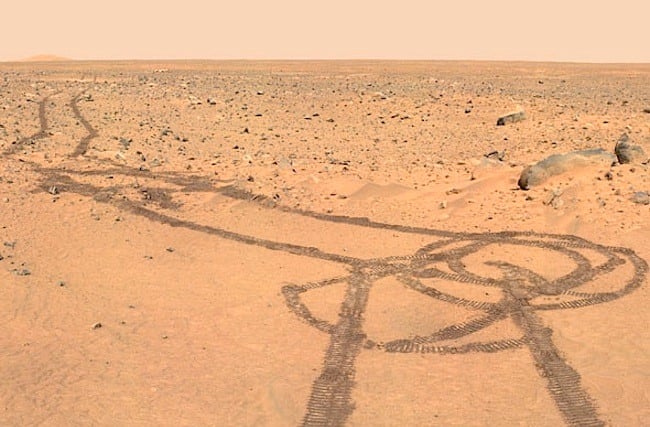
The infamous 'accidental' tracks left by the Spirit rover. You might say they made something of a boner
(source)
Perhaps better known are the Spirit and Opportunity rovers that were sent to Mars by NASA in 2003. Landing in 2004, the rovers surveyed the surface of Mars to look for signs of water activities. The Spirit rover became unresponsive in 2010 (maybe it became… SELF AWARE!! …no actually, they just lost contact with it), but the Opportunity rover is still rolling along the surface of Mars, nine years on from the start of the mission – not bad for a piece of equipment designed to last three months. Pros of this mission: it gave us insight into the geological history of mars. Cons: the spirit rover accidentally drew an *ahem* interesting shape on the surface of the red planet shortly after landing in 2004 – probably what it’s most famous for (welcome to the internet).

This blue dot is the first radio transmission from the first man-made object to leave our solar system. Or maybe its just something someone knocked up in Photoshop - who knows? (source)
So, it seems we have become quite adept at shooting robots into space – but what about beyond the limits of the solar system? Well, the closest we have come was when the Voyager 1 probe crossed over the outer limits of the solar system in August 2012 after 36 years in space and 11 billion miles traveled. In February 2013 a radio signal was received from the Voyager from beyond the orbit of our sun – the first signal to be broadcast from interstellar space. The signal was picked up by radio telescopes on earth as a tiny blue dot.

So why haven’t we gone outside our solar system? Traveling at the top speed of Earth’s current space shuttles (about 28,300 km/h) it would take 165,000 years to get to the Alpha Centauri system – several times longer than the written history of the human race - which makes for something of an inconvenient flight (Are we there yet?). And that’s only our closest star. Of course, one way we could go all over our galaxy (and beyond) would be travel very very very fast. Unfortunately this is never going to happen based on conventional jet propulsion systems as it takes 3,000,000 lbs of rocket fuel to send a shuttle just into Eath’s orbit, which is more than 15 times the mass of the shuttle itself, so you can imagine the amount of fuel required to take an interstellar star ship to Alpha Centuri. Engineers and scientists are working on this problem and there are several theoretical and proposed alternatives to conventional methods, but I will talk about those later – first we have to address perhaps the biggest obstacle to deep space travel.

The Speed Limit of the Universe

Much like the motorway/freeway/highway, everything in the universe has a speed limit but, unlike the speed limit on the roads, it is the speed of light and it cannot be broken. Well breaking the speed limit on the road is illegal but it is POSSIBLE – an act that I in no way endorse. Neither do I endorse breaking the laws of physics on the highway – that’s neither funny nor clever. Anyway, you guessed it folks – it’s time for the maths stick once again. In order to explain why nothing in the universe that has mass can travel faster in the speed of light we have to take a look at the most famous mathematical equation in history. You’ve guessed it:
E=mc

This is the equation for Albert Einstein’s famous theory of special relativity. In this equation E stands for energy, m stands for mass and c2 stands for the speed of light (300, 000, 000 meters per second ) squared. The c in this case stands for constant, as the speed of light in a vacuum which is always the same. Now – if you read my last article you might have guessed that I am not great at mathematics. In fact I suck at it (no – this is not an appropriate place to say ‘that’s what she said’) – so hopefully this explanation is satisfactory. 

Albert Einstein circa 1921, photographed Ferdinand Schmutzer (source)
The equation explains the relationship between mass and energy. I’m not a physicist and trying to explain this in detail would confuse everyone, most of all me, so I will keep it simple. Einstein’s theory states that mass and energy are interchangeable and are just two different forms of the same thing. The faster an object is moving, the more energy it has and therefore more mass. The closer an object gets to the speed of light, the more energy it has pushing it along which equates to more mass. 

So why don’t we notice this in real life? If energy has mass then why don’t we get heavier while we run? Why doesn’t a car get heavier as it gets faster? The answer is that it does happen – we just don’t notice it because it is so small – at the slower speeds we are used to on Earth the percentage of mass increase is tiny. It’s a different story close to the speed of light where the increase in mass would be colossal; in fact if an object moved at the speed of light it would become infinitely massive and have infinite energy. Even if the starting object has tiny mass, like a single electron, the end result would be the same.

So based on Einstein’s equation it would require an infinite amount of energy to travel at the speed of light, making it effectively impossible. So how might we overcome this obstacle if we are ever to travel to other star systems? Both science and fiction have several ideas to get over it.

Cheating Physics – Getting to Other Stars

As I mentioned earlier, our current technologies wouldn’t allow us to make the massive journeys between stars – even if we could get up to a decent speed, the amount of fuel required to power a large star ship would be a *ahem* $@#%load (scientific term). So one way we could approach being able to travel between stars is to develop more efficient propulsion systems.

There are several theoretical and proposed alternatives to current jet propulsion technologies. One such idea is using an antimatter rocket – a rocket engine which generates its thrust with antimatter. Antimatter is basically the ‘evil twin’ of matter particles in our universe – they are particles with the exact opposite properties of matter. For example, the antimatter equivalent of an electron is a positron. Electrons are negatively charged particles which are found in all atoms – their antimatter opposites have the same mass but the opposite charge. When a particle of antimatter meets a particle of matter they annihilate – a reaction which destroys both particles, converting them into the energy equivalent of the mass of both particles. Antimatter annihilation can produce an insane amount of energy from a tiny amount of matter which makes it an ideal rocket engine. Unfortunately antimatter is very hard to make and so far only 38 atoms of anti-hydrogen have been created, lasting only 0.2 seconds before annihilation. Another candidate for getting us close to light speed is nuclear fusion engines, which generate energy and thrust through the process of nuclear fusion – this is when two atoms fuse together to form a heavier element – releasing energy in the process. This is much more efficient than rocket fuel and could take us to (relatively) nearby stars with much smaller rockets.

So assuming we could use one of the many theoretical propulsion systems to get our space ships close to the speed of light and we wanted to travel to a star system a little less than 200 light years away, how would we deal with the problems of making the 200-or-so-year journey there? Again, there are several speculated solutions to this problem. A few of them are actually kinda weird. One proposal is a generation ship – a huge starship where the descendants of the original crew would be the ones arriving at the destination. Of course this would require building a ship capable of sustaining a functioning human society for 200 years, which I don’t think anyone knows how to even begin trying to do. Then we have suspended animation – this would work too for shorter journeys of a few years as well. This one has been in a good few Sci-Fi movies and shows – probably most recently in James Cameron’s 2009 epic, Avatar and the brilliant 2012 prequel to the Alien films, Prometheus by Ridley Scott. This method would involve slowing or pausing the aging process by freezing the passengers of a mission or putting them in deep sleep and waking them up at their destination – again unfortunately no such technology currently exists, but could offer a method of getting people to distant star systems in the future. Another idea is to send frozen fertilised human embryos into space and have them ‘revived’ by a robot (unfortunately not like C3PO) when they are within some years of their objective. Those are probably three of the least weird ideas – there are many more you can look up.

An almost-universally recurring staple of science fiction is faster than light, or FTL, travel. There are also many proposed mechanisms for this one and they are even more theoretical than the stuff I’ve mentioned before. Perhaps one of the more popular ideas found in sci-fi is that of using a wormhole to travel. This is another thing we have to thank Einstein for – working with a student by the name of Rosen he came up with the idea of Einstein-Rosen bridges – what have become known as wormholes. Wormholes are basically shortcuts through the fabric of space and probably the best way to explain it is the analogy which gives it its name. Imagine that the universe is a giant apple and you are at point A and want to get to point B which is on the other side of the apple. You would have to walk from point A to B which would take a few hours (it’s a really big apple) but a worm could get through the apple much more quickly (in less than one hour) by munching its way through the tasty tasty universe – by creating a wormhole. Unfortunately they are just theory at the moment and Einstein speculated that they would be very unstable and collapse almost immediately after coming into existence.  If we could work out a good way to create and stabilize wormholes (like a Stargate?) then we could, in theory, travel to distant stars and even galaxies almost instantaneously.

Well, that about wraps it up for this week. I know what you are thinking: ‘Adam, you should stick to the biological sciences.’ – if you have any complaints about the length, content or nonsensical-ness of this article, please write to our complaints department at 123 Fake Str… oh, sorry – we don’t have one. My mistake.

Thanks for reading, remember to check out and Like the Facebook page (https://www.facebook.com/scienceunplugged) to support ScienceUnplugged and to see notifications of new posts, science news and interesting things.

As with every article I post here, this one has been thoroughly researched and a list of sources can be provided for anyone who is curious – just check out the contact page.

Wednesday, 11 September 2013

The Science of Sci-Fi: Aliens


It is probably pretty clear from the fact that I run this blog that I am something of a nerd. And what do us nerds love more than anything? No, not energy-drink-fuelled inflammatory rants on message boards, its Sci-Fi! Everyone loves a bit of cheesy, space-battling, laser shooting sci-fi action. Turns out that a lot of the ideas in science fiction have some basis in science fact. If you’ve been reading ScienceUnplugged up until now you know the routine – yup: I’m gonna ramble about a few. In this part I am going to talk about Aliens (YAY!)

Evidence – Europa and Mars

So normally when you see the word ‘Aliens’ on a blog, things go downhill rapidly. There will be none of that sort of thing here. Like how the aliens are abducting everyone and replacing people with hybrid clones… kidding. If you haven’t read my last article about extremophiles you should give it a quick read because a lot of is relevant to the alien conspiracy.

Surprisingly, the concept of alien life isn’t actually a stranger to science. I mentioned in my last article about the theories about extra-terrestrial life involved in microbiology. There are a few signs that suggest that life exists or could exist on other planets in our solar system. 

europa, ice, moon, aliens, extra-terrestrial, sci-fi, star trek, stargate, battlestar, star wars
The ice moon Europa, which turns out is kinda ginger... (source)
One example of this is the ice moon Europa. Europa is one of the moons of Jupiter and is about the same size as Earth’s moon. The entire surface of the planet is covered in ice and scientists believe that a water ocean could exist beneath the ice layer. In my last article I talked a little bit about hydrothermal vents – deep sea chimneys that spout mineral-rich water heated by molten rock in volcanic regions of the sea floor. It is theoretically possible that these vents could exist on Europa and create oases of life on the ocean floor, much the same as they do here. If these places exist on Europa, they would be perfect for critters like giant tubeworms and the ultra-resilient microbe Methanopyrus kandleri.

Another interesting thing about Europa is the red marks visible on its surface. Some have speculated that these could be caused by red-pigmented microorganisms growing in characteristic patterns called blooms, similar to those that can be seen all over planet Earth. As far as theory goes, Europa is probably the most probable candidate for life outside of earth. As for actually proving it… that’s another matter altogether. The European Space Agency is planning to launch a mission to study three of Jupiter’s icy moons called the Jupiter Icy Moon Explorer (JUICE) - so maybe we will find out after 2022 when the mission is planned to take place.

mars, planet, aliens, extra-terrestrial, sci-fi, star trek, stargate, battlestar, star wars, viking
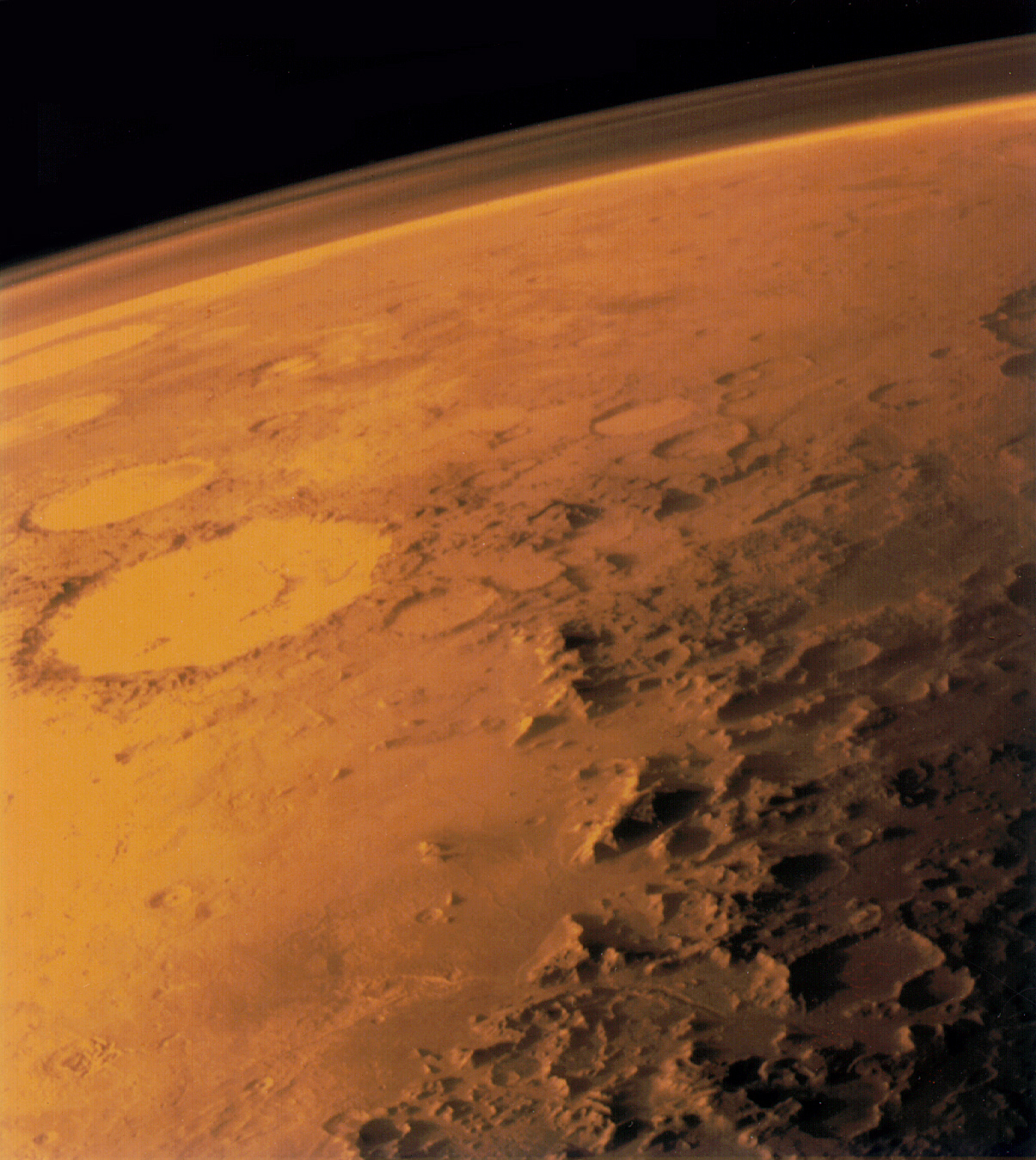
The surface of mars as seen by the Viking Orbiter... do you think martians like to eat MARS-ipan...? Hahaha haha ha ...sorry (source)
Mars has also received much attention as a potential life-supporter. My thesis adviser in my undergraduate degree would always say ‘water is life’. Here on Earth, everything alive requires and is largely made up of water. If water can be identified on a planet it may represent a foundation for life. Several efforts have been made to survey the conditions on mars and several clues about the presence of water on the red planet. Mars has polar ice caps composed mainly of water which also give rise to water vapor clouds. If frozen water can be found on the planet then perhaps liquid water is a possibility also. The conditions on mars can be best described as cold and dry across most of its surface with many volcanoes and the previously mentioned ice caps. On earth, microorganisms have been found which can live in similar temperatures and conditions. 
alien, grey, ET, extra-terrestrial, sci-fi, star trek, stargate, battlestar, star wars
Science hasn't proved this guy real yet - sorry (source).

I know what you are thinking – bacteria and algae don’t really measure up to the imaginative range of green, blue, purple, orange and grey skinned, tentacled and/or antennae’d creatures that show up in SciFi shows, movies and games. What is particularly interesting about the deep sea vents I mentioned is that they create the conditions for simple life forms to thrive and become the bottom rung of the food chain where they act as the food source for more complex creatures.


Probability – The Drake Equation

Another clue that extra-terrestrial life may exist is the fact that it is technically quite probable. That probably seems like a strange thing to say until you think about it: if you look into the sky on a clear night you will see a lot of stars just like our sun. We live on a single planet out of nine orbiting our sun – the only planet we know of that supports life. If even a very small portion of those stars has just one planet like Earth, then the chances of life existing elsewhere in the galaxy seem quite high.

Okay, now it gets complicated. That’s right – I’m breaking out the maths stick. It may or may not surprise you to learn that astrophysics has come up with an equation to determine the probability of extra-terrestrial life existing in our galaxy. The equation was invented by American astrophysicist Frank Drake in 1961 and goes something like this:

N = N* fp ne fl fi fc fL

frank drake, drake equation, scientist, astrophysics, sci-fi
Frank Drake - inventor of the euquation - he gets all the ladies now (source)
If you are anything like me, that means absolutely nothing to you. I will try and translate it a little. N is what the calculation was designed to calculate: the number of alien civilizations which could potentially exist in the Milky Way. N* is the number of stars in the Milky Way – which is currently estimated to be around 100 billion. fp is the percentage of stars that have planets around them - currently estimated to be between 20% and 50%. ne is the number of planets which have the necessary conditions to support life – the estimate on this one is between 1 and 5 – because I have only talked about Europa and Mars I’m gonna call it 3. 

The rest of the values in the equation are a little harder to answer and a little more complicated. fl is the percentage of the planets which can support life (ne) where life actually evolves. All we really have to go on for this one is Earth – while there may be some limited evidence and theories about life on other planets, we can’t actually prove whether there is life there or not just yet. It seems that life on Earth started quite early in its history, which leads astrophysicists to believe that life began on Earth as soon as it was ready to support it. Based on this fact, some scientists say that the value for Fl should be at 100%.

A baby hamster inside some kind of fruit and/or vegetable (it was kinda hard to find relevant pictures for this section (source).
That brings me on to fi – the fraction of planets where intelligent life arises. Like many of the terms in this equation, this one is pretty vague and hard to define, as is the trait of intelligence itself. Some might define this as a human-like level of intelligence – the ability to shape the world and develop technology to enhance survival and to communicate with each other. Others might define intelligence as a survival trait which allows animals to adapt to their surroundings and survive life-threatening situations. These definitions give us very different estimates for fi – on Earth only one species out of millions has evolved intelligence by the first definition which would give us an estimate for fi which is very low, whereas intelligence by the second definition is a basic requirement for a species to survive and would give an fi value between 50 and 100%.

fc is the fraction of intelligent life that has the ability and will to communicate through the development of science and technology. Again, this one is hard to define. On Earth, it took one civilisation – the ancient Greeks – to get the ball rolling on science and technology which eventually brought us to the point today where we can look beyond our planet and even beyond our solar system and galaxy. This one is pretty subjective, but it seems to me that such advancements in science and technology are vital to the survival of life on a planet, so I am going to call it 100% - you may disagree though.

On to the final value – fL. This is the fraction of a planet’s lifespan in which intelligent, communicating life lives and is probably the hardest value to answer. The predicted lifespan of Earth is about 10 billion years and we have been communicating wirelessly for less than a century and honestly, things aren’t looking great for human civilization. But let’s say we don’t nuke each other into oblivion or destroy our planet with pollution and survive and prosper for another ten thousand years, that would give us an fL value of 1 millionth.
                                                                                                                                                                                   
If I put all the values into the equation (a lot of it is personal opinion and guesswork unfortunately), I get an N value of 90 thousand estimated communicating civilizations in our galaxy. You can’t really take my word for this though – everyone filling in the equation with their best guesses will get a different answer which can range from tens to billions. 

So I guess the answer to whether there are alien civilisations like those we see on the cinema screen is… 

…probably.

You can make your own estimates and try them out in the equation here.
Stay tuned for the next article in the series – interstellar travel…

Remember to check out and Like the Facebook page (https://www.facebook.com/scienceunplugged) to support ScienceUnplugged and to see notifications of new posts, science news and interesting things.

As with every article I post here, this one has been thoroughly researched and a list of sources can be provided for anyone who is curious – just check out the contact page.